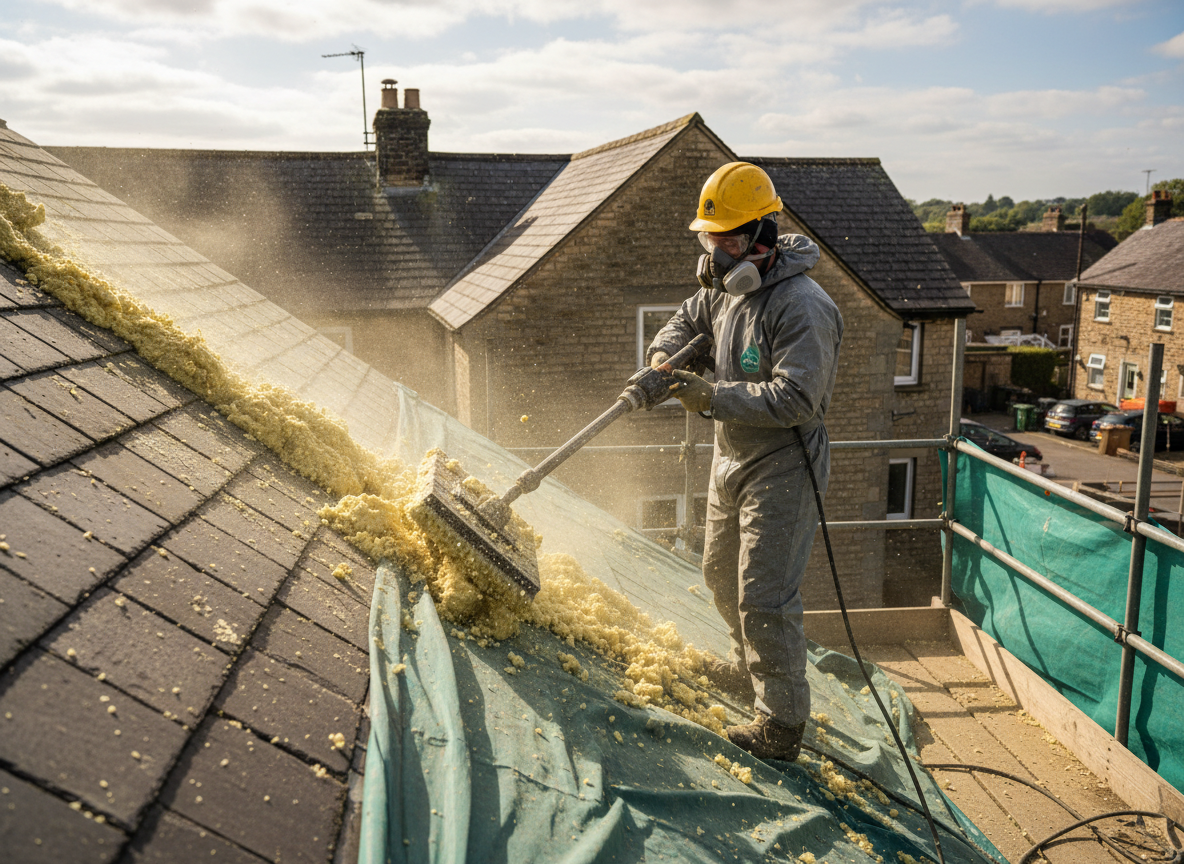
Yeovil's housing stock includes many pre-war terraced and semi-detached homes with pitched slate roofs where closed-cell spray foam was applied directly to the underside of tiles and rafters. In Somerset's frequent rainfall and mild winters this foam often traps moisture against timber, accelerating rot along the eaves and around chimney stacks. Removal requires careful scoring and peeling in sections to prevent tiles from dislodging on the steep pitches common around the town centre and along Goldcroft.
Polyurethane foam bonds aggressively to both timber and masonry in these older roofs, especially where previous condensation has created a damp interface. Technicians must work from boarded walkways to avoid damaging ceiling plaster below while using negative-air machines to contain dust during mechanical scraping. Local building control expects restored ventilation paths once the foam is gone, particularly in properties near the railway line where airflow patterns already struggle with the surrounding hills.
Edge cases appear regularly in Yeovil when foam has been sprayed over existing insulation or electrical cables, requiring isolation of circuits before any cutting begins. Waste must be bagged and removed the same day because Somerset's damp air quickly turns removed foam into a heavy, slippery load on ladders and scaffolding. Homeowners along Princes Street and nearby side roads often discover hidden water staining only after the foam is stripped, revealing leaks that need addressing before re-insulation.
Technician insight
In Yeovil the thing that catches most people out with roof spray foam removal is how the constant damp from Somerset winters makes the foam grip tighter to rafters in the older terraced houses around the town centre, so any rushed pulling risks splitting timber that has already softened from trapped moisture.
Pitched Roof in Central Yeovil
Homeowner reported musty smells and sagging ceiling plaster in a pre-war terrace near the railway. Inspection found closed-cell foam sealing the entire roof slope and trapping condensation against the rafters. We removed the foam in sections, cleared residue, and opened the eaves for airflow. The ceiling dried out and no further timber treatment was required.
How it works
- 1
Site Inspection
Assess roof structure, foam thickness, and any hidden moisture damage from a boarded walkway inside the loft.
- 2
Containment Setup
Install dust barriers, negative-air extraction, and floor protection to keep debris out of living spaces below.
- 3
Foam Extraction
Score and peel foam in controlled sections using hand and low-speed mechanical tools to protect rafters and tiles.
- 4
Cleanup and Ventilation Check
Remove all residue, bag waste for off-site disposal, and confirm clear airflow paths meet current standards.
Pricing
Pricing depends on roof size, foam depth, and access difficulty; upfront quotes given after inspection.