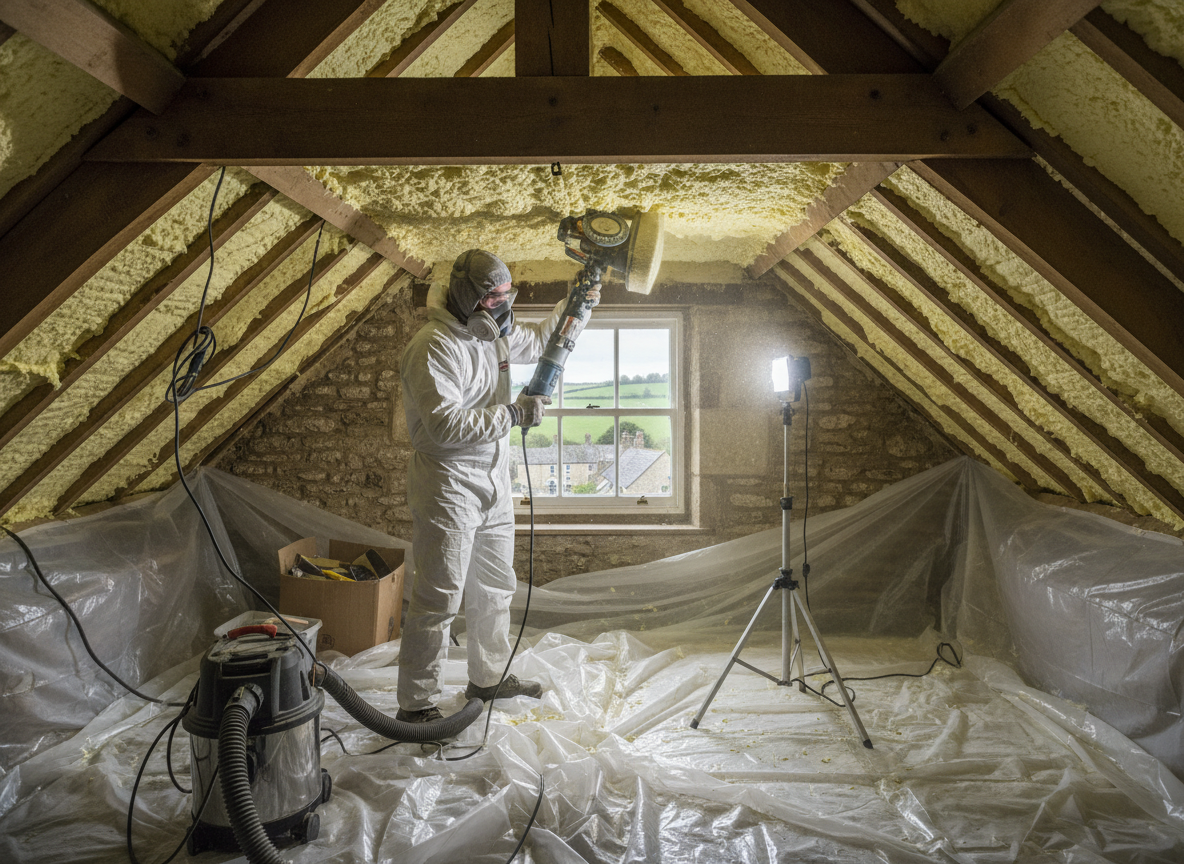
Residential spray foam removal in Yeovil often involves older terraced homes and stone cottages common in the area, where closed-cell foam was applied directly to roof voids and under floors. Extraction requires isolating the work zone to prevent dust migration into living spaces, especially when foam has degraded and bonded to original lath or timber. Local crews must also account for limited access points typical of Somerset properties, using sectional cutting and negative air machines to contain particles during the process.
Edge cases frequently arise when foam was installed over existing insulation or in properties near the River Yeo, where higher moisture levels can make the material brittle or waterlogged. Removal teams inspect for hidden electrical runs and ventilation paths before starting, then bag waste for proper disposal at licensed Somerset facilities. Homeowners are advised to avoid DIY attempts because disturbing aged foam releases isocyanates and requires full PPE protocols that most residents lack.
Regulation notes include checking that any disturbed areas meet current building standards for insulation replacement once removal is complete. In Yeovil, crews routinely verify that extraction does not compromise structural timber in period buildings before final clearance. Work is scheduled around weather windows to keep roof voids dry during the job.
Technician insight
In Yeovil, the thing that catches most people out with Residential Spray Foam Removal is how tightly the foam bonds to the original lath in Victorian terraces around Princes Street and nearby streets, especially when winter damp has already started breaking it down and pulling ceiling finishes with it.
Foam Extraction from a Yeovil Stone Cottage
Homeowner in central Yeovil reported persistent loft odours after years of spray foam. Inspection revealed waterlogged foam trapping moisture against rafters. Crew removed the material in small sections to protect the plaster ceiling below, ventilated the void, and cleared all debris. The property now has dry, accessible roof space ready for proper ventilation upgrades.
How it works
- 1
Initial Assessment
Technician inspects the property in Yeovil to map foam locations, check access routes, and identify any moisture or structural concerns.
- 2
Site Preparation
Containment barriers and negative air filtration are set up to protect living areas from dust and debris during removal.
- 3
Foam Extraction
Foam is cut and removed in controlled sections using hand tools and vacuums suited to tight Somerset roof voids.
- 4
Cleanup and Disposal
All residue is collected, surfaces are wiped, and waste is transported to approved disposal sites serving the Yeovil area.
- 5
Final Inspection
Property is checked for clearance and homeowners receive guidance on next steps for re-insulation if required.
Pricing
Upfront quotes provided after on-site inspection; cost varies with foam depth, access difficulty, and property size.