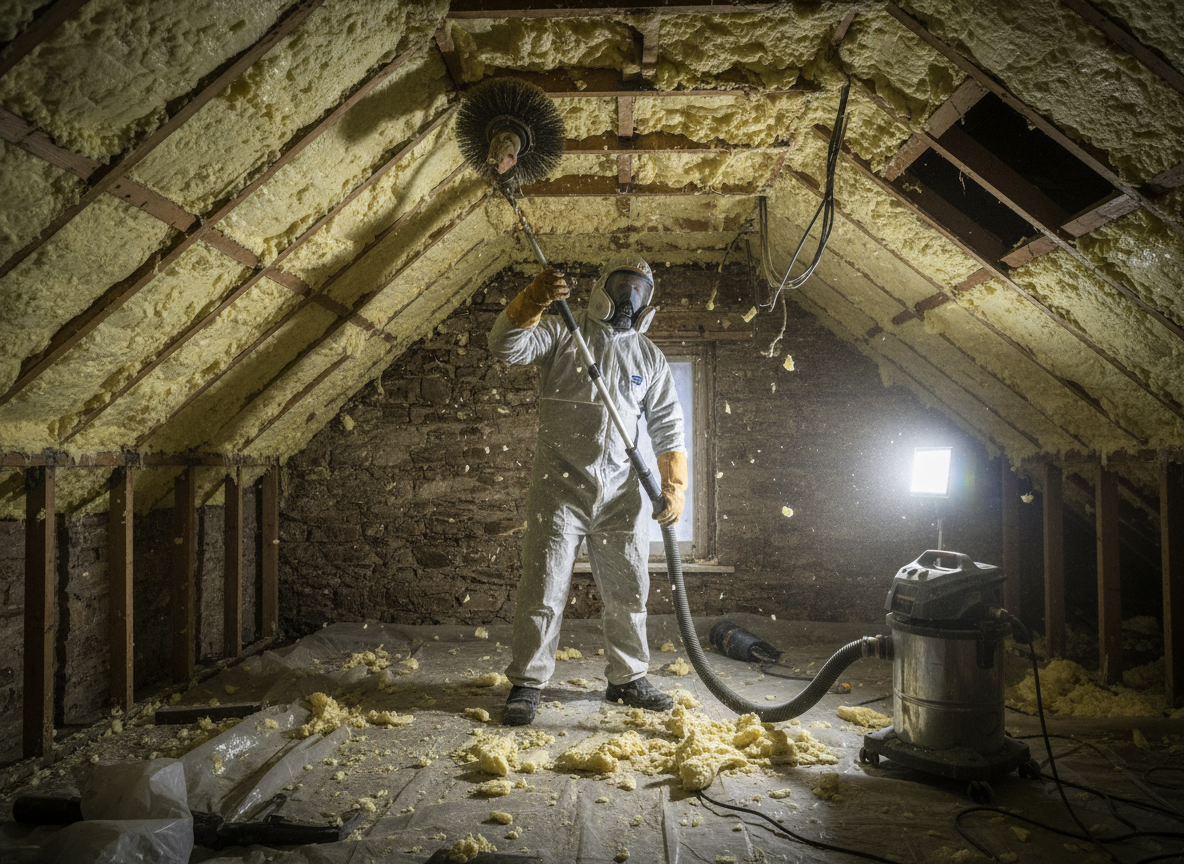
Thermal spray foam removal in Yeovil requires careful control of heat application to avoid damaging underlying timber or plaster in the area's many post-war and Victorian terraces. Foam often bonds tightly to lath ceilings and joists in homes around the town centre, where years of condensation from Somerset's damp winters have already softened the substrate. Technicians must monitor temperature zones closely because excessive heat can release trapped moisture from the clay-heavy soils that underlie much of Yeovil, leading to further structural weakening if not addressed during extraction.
Edge cases frequently appear in semi-detached properties near the A30 corridor, where foam was sprayed over electrical cables or pipework without proper separation. These installations demand sequential removal passes and immediate inspection to prevent short circuits once the insulating layer is gone. Local building practices from the 1970s and 1980s often left minimal ventilation gaps, so crews must restore airflow paths to meet current Somerset building control expectations without adding new materials that could trap future damp.
The process also accounts for access limitations common in Yeovil's narrow terraced streets, where equipment must be carried through front doors rather than lifted to roof level. Waste must be bagged on site to contain particulates that could otherwise settle on neighbouring gardens or pavements, especially during the wetter months when wind carries debris further.
Technician insight
In Yeovil, the thing that catches most people out with thermal spray foam removal is how the foam was often sprayed straight onto lath and plaster in 1930s terraces along Princes Street and nearby roads, where the underlying timber has already absorbed moisture from the local clay subsoil.
Foam Removal in a Yeovil Terrace Attic
Homeowner noticed musty smells and poor loft ventilation in a 1930s terrace near the town centre. Inspection found spray foam bonded directly to ceiling joists with damp patches from roof leaks. Crew used controlled heat to release the foam in sections, cleared the waste, and opened original vents. Airflow returned and the smell disappeared without further ceiling damage.
How it works
- 1
Site Assessment
Inspect foam depth, substrate condition and access routes in the Yeovil property before any heat work begins.
- 2
Containment Setup
Seal rooms and install extraction ventilation to manage dust and odour during thermal removal.
- 3
Controlled Heat Extraction
Apply targeted heat to soften and peel foam in layers while protecting joists and wiring.
- 4
Waste Removal and Clean Down
Bag all material on site and vacuum surfaces before final walkthrough.
Pricing
Cost depends on property age, foam thickness and access difficulty; request an upfront quote based on inspection.